SERIES: GETTING YOUR AGENCY READY TO SELL YOUR BUSINESS | PART 1
Most agency owners who start thinking about selling make the same mistake: they anchor on a number they hope their business is worth, then work backwards to justify it. That number is usually wrong — and when reality hits during a negotiation, deals fall apart.
Nicole Pereira has been through the merger and acquisition (M&A) process more times than most — and not always smoothly. She's made three exits, helped her husband acquire and turn around an agency, and once entered a merger that ended in court. That experience—a legal dissolution that drained time, money, and energy unnecessarily—sharpened her perspective on how these deals should, and should not, be structured. She learned it the hard way so you don't have to.
Her starting point for every deal is the same: understand how your business is valued before you talk to anyone. Not because the number is everything — but because it shapes every decision that follows. This is that foundation.
Why Revenue Isn't the Number That Matters
Most first-time sellers assume their business is valued on revenue, the total amount of money it brings in. but it isn’t. Most small agencies are valued on a Seller's Discretionary Earnings (SDE), which most founders have never heard of before their first deal conversation.
To get to SDE, you first need to understand the simpler number underneath it: Earnings Before Interest, Taxes, Depreciation, and Amortization (EBITDA). Once you have both, you'll understand exactly how a buyer calculates what your business is worth.
The Two Numbers That Determine Your Price
Earnings Before Interest, Taxes, Depreciation, and Amortization — Your Profit Margin
EBITDA for a small agency means your profit — what's left over after you've paid your team, your tools, your rent, and everything else it takes to run the business.
Nicole's target for a healthy agency is around 20%. So if your agency earns $1,000,000 in revenue and your EBITDA is 20%, that means $200,000 is left as profit after all costs. That number tells a buyer your business is sustainable and worth taking seriously.
If your margin is too low, buyers question whether you know how to run a profitable shop. If it's too high for too long, they wonder if you've been cutting corners on growth. The 20% target, averaged over a few years, is the sweet spot.
Seller's Discretionary Earnings — The Number Your Business Is Actually Sold On
Think of SCE as a truer version of your profit, one that adds back expenses that were real costs during your ownership but won't exist once you're gone.
"Seller's Discretionary Earnings is your EBITDA with add backs… you can add that back."
These add-backs are things you spent money on as the owner that a new owner simply won't spend. Nicole's examples:
- Your salary is above what a replacement CEO would cost. If a market-rate CEO would cost $120K and you've been paying yourself $170K, that $50K difference is an add-back.
- One-time legal fees. Costs like M&A advisory that won't repeat after the sale.
- Personal expenses run through the business. Trips that weren't essential, your phone bill, other personal costs the company covered.
How a Multiple Turns SDE Into a Sale Price
Once you have your SDE, the purchase price is calculated by multiplying it by a number called a multiple. For digital agencies, Nicole says multiples typically range from 2.5 to 4 times the SDE.
The multiple is the buyer's way of pricing that risk. The less the business depends on you personally, the more predictable its revenue, and the stronger its team — the higher the multiple you can command.
What pushes your multiple up
- Recurring revenue — retainers and contracts that renew automatically, not projects you have to resell every cycle
- A leadership team where every function has a named owner who isn't you
- A sales pipeline that generates business without your personal relationships driving it
- Consistent, stable margins over 3+ years
What pulls your multiple down
- Client concentration — if one client leaves and your revenue drops significantly, that's a red flag
- Project-heavy work — constantly hunting for the next client creates unpredictable cash flow
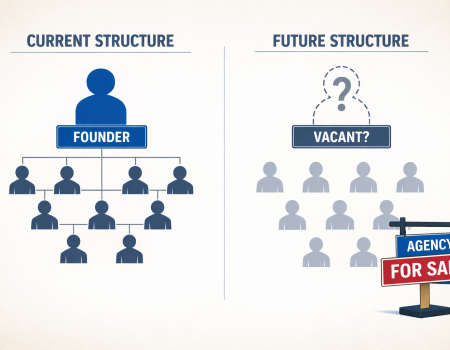
- Founder dependency — if the business only works because you're in it, a buyer has to hire to replace you, and that cost comes off your price
- Declining revenue or margins with no clear path to recovery
The Single Biggest Thing Killing Agency Valuations
"I don't want a business that if the CEO leaves, everything falls apart."
Nicole makes this point as a buyer, and it’s the clearest signal in the entire series: a business that can run without its founder commands a premium. A business that depends on the founder for every client relationship, every sale, and every key decision gets discounted because the buyer is essentially purchasing a job, not a company.
We'll cover exactly what to do about this in Part 4. For now, understand that every role you currently fill personally is a cost a buyer will subtract from your multiple. The sooner you start removing those dependencies, the more your business is worth.
Closing Thought
Understanding your value is the foundation for every M&A decision that follows. Before you worry about deal structure or taxes, know your SDE. Know your multiple range. Know what's holding your multiple back. Everything else in this series builds from here.
Up next in Part 2: What buyers and lenders actually look at when they evaluate your business and why the document you've been polishing probably isn't the one they care about most.
This four-part series is based on a conversation with Nicole Pereira, serial founder and three-time agency seller.